
9 April 2026 – The QVAC team at Tether today announced the launch of QVAC SDK, a fully open-source cross-platform Software Development Kit designed to become a universal Artificial Intelligence building block, in a world where, soon, 10 billion humans will share this planet with 10 billion autonomous machines and a trillion AI agents. We call it the “Stable Intelligence Era”.
At Tether, we are building the foundational layer for the next era of compute. We see AI as a new element of the periodic table – a raw material that can be embedded into the very fabric of the universe. QVAC is the atomic unit of this new world. It is a modular, highly efficient, local-first AI platform designed to run anywhere, on any device, platform, and operating system. From the most powerful industrial server to the smallest chip in a light bulb. We are designing AI like a highly sophisticated interlocking intelligence system: standardized, stackable, and infinitely scalable. With the current limitations of edge AI, both in terms of models and hardware, diluting quickly over time, QVAC is the first intelligence framework that can evolve with silicon, that adapts to the future, for the next tens, hundreds, millions, and billions of years.
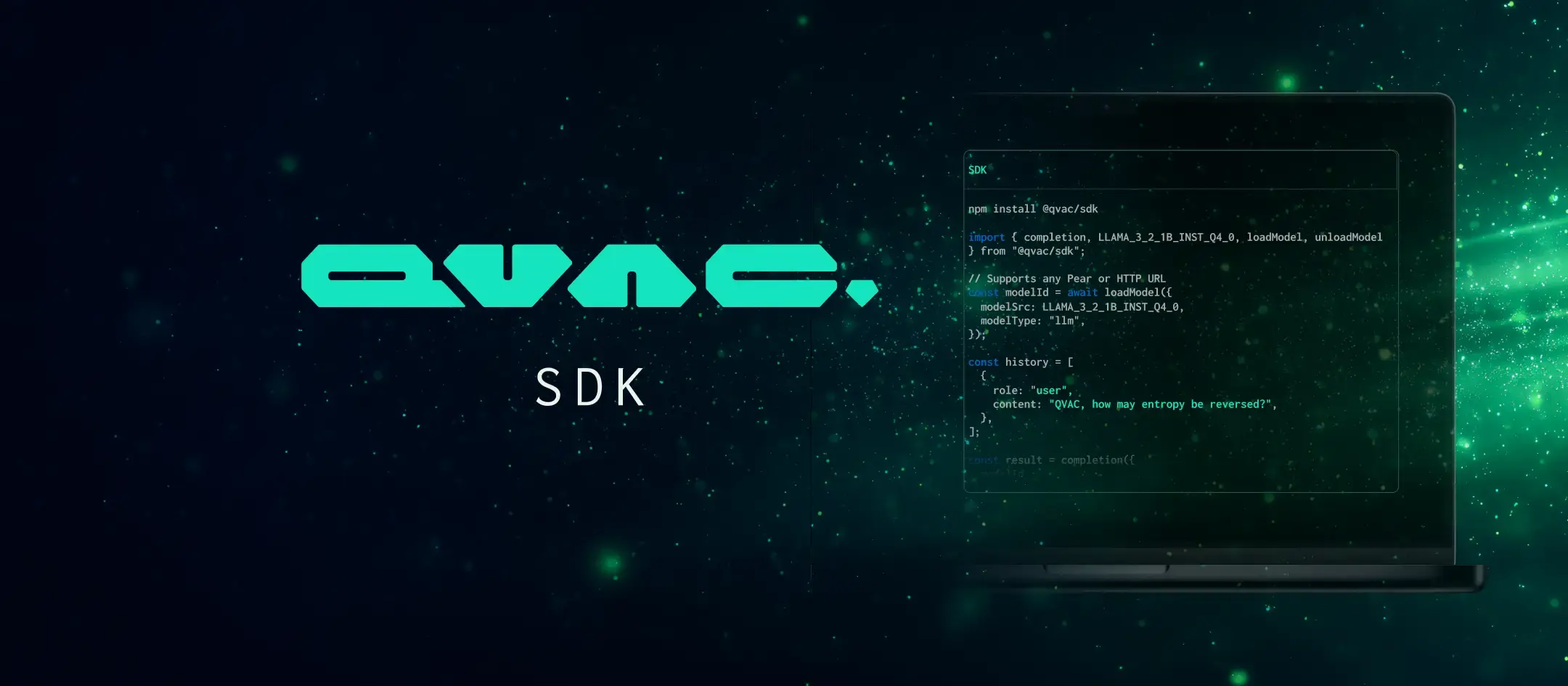
QVAC SDK is a unified software development kit that enables developers to build, run, and fine-tune AI directly on any device, consistently across environments. Its vision is simple but radical: intelligence should not be a service one rents. It should belong to the people who use it. This new breakthrough framework enables intelligence tools such LLMs, as well as other most used AI constructs, to be executed at scale directly on consumer devices, smartphones, laptops, desktop computers, and even industry-grade servers. Applications built with the SDK can run unchanged across iOS, Android, Windows, macOS, and Linux. The same codebase executes across all supported environments, without platform-specific branches, rewrites, or conditional logic. A new paradigm empowering 100% private and personal intelligence.
For consumers, this means the AI features they use every day, from writing assistance and translation to voice transcription, image generation, personal accounting, daily finance planning, summarization, smart searching, and much more, can operate instantly on their devices without sending sensitive data back and forth to remote servers. QVAC-powered applications continue to work even in low-connectivity environments, making AI more practical in real-world use cases. If the internet goes down, the AI keeps working. If a server farm goes offline, nothing changes for the user.
For developers, the SDK simplifies the building and deployment of local AI across platforms, helping teams launch once and deliver a consistent experience everywhere. Rather than managing separate implementations for different operating systems or relying entirely on cloud APIs, developers can focus on building products that feel faster, more personal, and more resilient.
At the core of the SDK is a unified abstraction layer over multiple local inference engines. QVAC SDK is built on QVAC Fabric, a fork of llama.cpp, providing broad compatibility with the llama.cpp model ecosystem for text generation, embeddings, and multimodal workloads. The SDK also integrates additional best-in-class local engines, including whisper.cpp and Parakeet for speech-to-text and Bergamot (NMT) for on-device translation. These engines are exposed through a consistent API, allowing developers to combine or switch capabilities without changing application logic.
“The world is approaching a moment where billions of humans share the planet with billions of autonomous machines and trillions of AI agents,” said Paolo Ardoino, CEO of Tether. “The current model, routing every decision through a centralized server, won’t scale to meet that reality. The laws of physics alone make centralized AI a dead end: speed-of-light latency, single points of failure, and concentration of control are features of a system designed for a smaller world. QVAC is built for the world that’s coming. It is the building block of the Stable Intelligence Era.”
Peer-to-peer functionality is also one of the primary components of the SDK. Powered by the Holepunch stack, QVAC SDK includes built-in primitives for decentralized model distribution, delegated inference without centralized infrastructure, and soon, peer-to-peer swarms for decentralized training, fine-tuning, and inference. All peer-to-peer behavior is handled transparently and operates identically across platforms, enabling resilient local AI applications that do not depend on any centralized services.
Through a single interface, the QVAC SDK supports a growing range of capabilities, including text completion, embeddings, vision, OCR, text-to-speech, speech-to-text, translation, and more. Developers can access these capabilities without managing separate toolchains or platform-specific integrations. In the coming months and years, Tether will commit substantial resources and investments to expand QVAC’s open-source ecosystem to cover all necessary functionality, including toolkits specifically designed for robotics and brain-computer interfaces.
As AI becomes embedded in physical systems, infrastructure, and everyday life, the latency and fragility of centralized models become an engineering problem, not just a political one. The launch reflects a broader shift in how AI is being deployed, moving from cloud-dependent models toward approaches that prioritize on-device intelligence. As consumer expectations around speed, privacy, and control continue to grow, local AI tools like QVAC SDK aim to give developers a new path to building the next generation of intelligent applications.
More information about QVAC SDK is available at https://qvac.tether.io.
About Tether Data
Tether Data, S.A. de C.V. (“Tether Data”) is part of Tether’s broader vision to advance freedom, transparency, and innovation through technology. Its mission is to enable people and organizations to connect and share information directly, without unnecessary intermediaries. By creating secure, peer-to-peer systems, Tether Data gives users greater control over their data, communications, and digital interactions. Tether Data aims to redefine how information flows across networks by replacing centralized models with decentralized infrastructure designed for privacy, efficiency, and resilience. The company’s goal is to make global connectivity faster, safer, and more private, empowering individuals and institutions alike to exchange information freely and securely.
About QVAC
QVAC is Tether Data’s advanced AI research initiative dedicated to building open, decentralized, and adaptive intelligence systems. Its mission is Local AI and Infinite Intelligence. It is guided by an uncompromising vision of a world where AI lives and learns on any device, empowering individuals and communities rather than concentrating power in corporate data centers.