
The 191-billion-token dataset helped smaller AI models outperform open-source baselines across science and reasoning tests, supporting advances towards AI tutors and technical assistants that can run locally
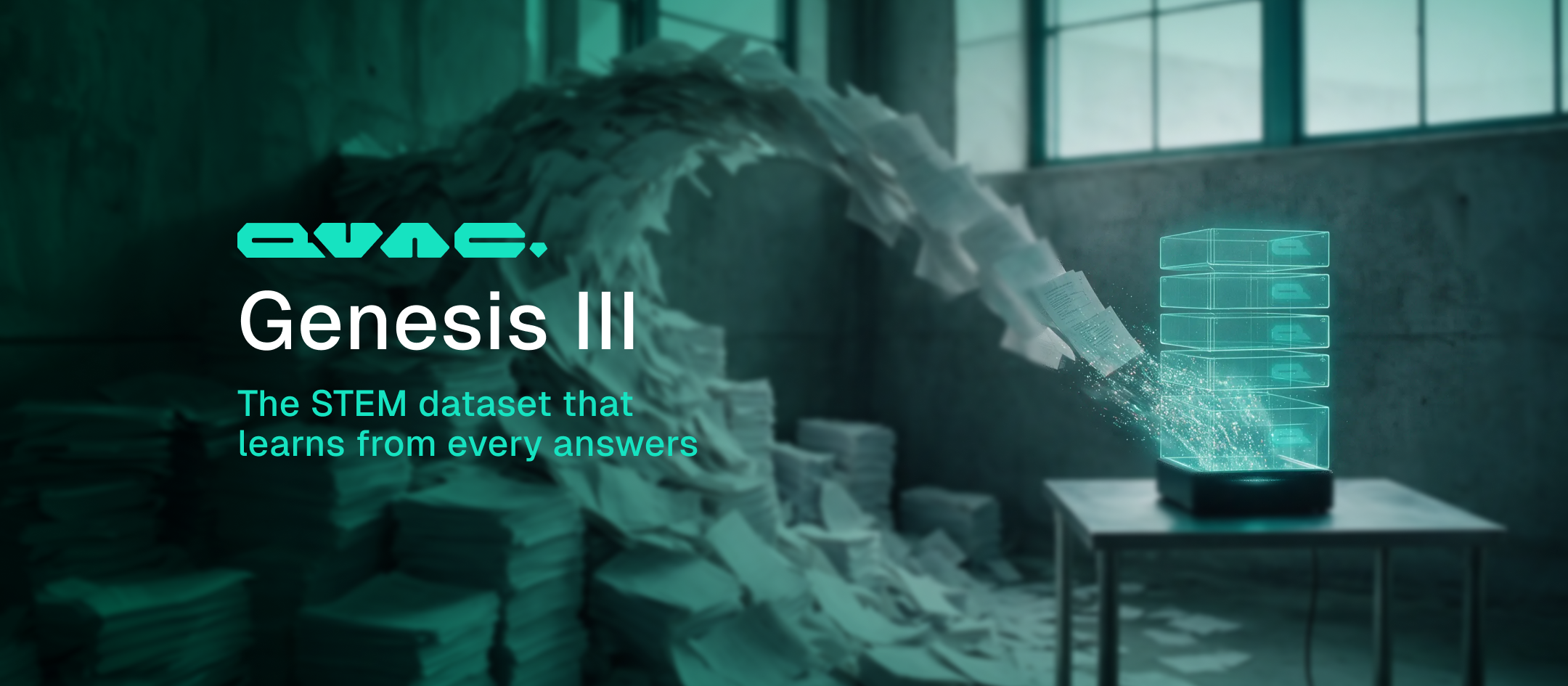
23 September 2026 – Tether AI Research* today released QVAC Genesis III, a 191.43-billion-token synthetic dataset designed to make smaller AI models more capable at science, technology, engineering and mathematics.
The research tackles a central challenge in bringing AI onto everyday devices: smaller models require less computing power and can run on laptops, phones and local servers, but often give up capability compared with much larger systems. Genesis III focuses on closing that gap by improving what those models learn from rather than simply making the models bigger.
The result moves us towards AI tutors and specialized technical assistants that work directly on a user’s device instead of requiring every question to be sent to a large cloud model.
Genesis III builds on QVAC Genesis I and Genesis II, released on 24 October 2025 and 22 December 2025, respectively, expanding the corpus to 191.43 billion tokens across 159.6 million documents. The QVAC Genesis III paper has also been accepted for presentation at the Conference on Language Modeling (COLM) 2026, where Tether AI Research will present the work alongside research from the broader language-model community.
Key Findings
In testing, models trained on Genesis III outperformed comparable open-source training datasets across science and STEM reasoning benchmarks. A 1.7-billion-parameter model trained on its Option-Level data delivered valid answers in 99.45% of benchmark responses, while models trained on the full corpus posted substantial gains against other open-source baselines.
Education is one of the clearest applications for the research underlying Genesis III. Genesis III spans 19 curriculum-aligned STEM areas across high school, college, and professional levels, including biology, chemistry, physics, mathematics, computer science, medicine, astronomy, electrical engineering, statistics, and machine learning. For a student, this research could mean an AI tutor that works through a physics problem, explains why a math answer is wrong, and identifies where the reasoning broke down. Because smaller models can run locally, those tools could also work in schools and communities with limited connectivity and in settings where privacy or the cost of continuous cloud access matters.
An Aid to Reasoning
For researchers and professionals, the same approach could support specialized technical assistants that run locally without continuously sending questions or sensitive information to an external server.
Genesis III contains 159.6 million documents and uses two methods designed to teach models more from each problem rather than relying on conventional question-and-answer training:
- The first, Failure Analysis, turns a smaller “student” model’s mistakes into new training material. A more capable teacher model identifies where the reasoning went wrong, explains the misconception, and works through the correct solution.
- The second, Option-Level Reasoning, takes questions the model answered correctly and explains both why the answer is right and why each alternative is wrong.
Together, the methods are designed to teach models not only how to reach an answer, but how to recognize faulty reasoning and correct mistakes.
Performance Comparison
The researchers found that Genesis III’s Option-Level dataset outperformed equivalent Cosmopedia-v2 training across multiple model architectures, including Qwen, Llama, SmolLM, and Gemma. Models trained on the full Genesis III corpus also recorded significant gains. Compared with a token-matched Cosmopedia-v2 model, Genesis III improved performance by 28.57 percentage points on ARC-Easy, 21.35 points on ARC-Challenge, and 15.03 points on the MMLU STEM benchmark. Genesis III pre-trained model also outperformed Cosmo-1B, a larger model trained with additional mathematics and code data, across the benchmarks evaluated in the study.
“Most of the AI industry has focused on making models bigger and giving them more computing power. Genesis III shows what can happen when you focus instead on making the data smaller models learn from better,” said Paolo Ardoino, CEO of Tether. “For STEM, that means teaching a model more than the final answer. It means teaching it why something is right, where reasoning went wrong, and how to correct it. The goal is to move useful AI from large cloud infrastructure onto the devices people already have.”
About QVAC
QVAC is Tether’s advanced AI research initiative dedicated to building open, decentralized, and adaptive intelligence systems. Its mission is Local AI and Infinite Intelligence. It is guided by an uncompromising vision of a world where AI lives and learns on any device, empowering individuals and communities rather than concentrating power in corporate data centers.
About Tether AI Research
Tether AI Research is part of Tether’s broader vision to advance freedom, transparency, and innovation through technology. Its mission is to enable people and organizations to connect and share information directly, without unnecessary intermediaries. By creating secure, peer-to-peer systems, Tether AI Research gives users greater control over their data, communications, and digital interactions. Tether AI Research aims to redefine how information flows across networks by replacing centralized models with decentralized infrastructure designed for privacy, efficiency, and resilience.
*References to Tether AI Research mean Tether Data, S.A. de C.V.